

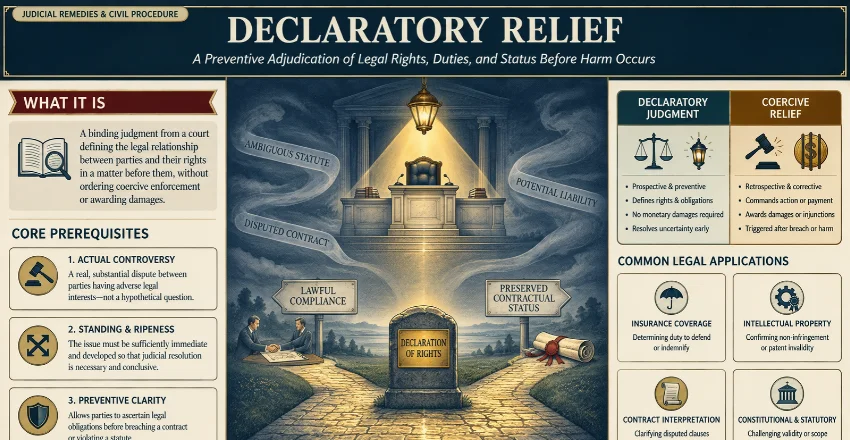
Declaratory relief lets a court settle a genuine legal dispute by formally defining the parties’ rights or obligations. It usually does not order payment or force someone to act. Instead, the judgment can resolve uncertainty before a dispute causes greater legal or financial harm.
This remedy commonly appears in contract, insurance, property, constitutional, intellectual property, and business disputes. Federal courts require a real controversy rather than a request for general legal advice. State courts also provide declaratory remedies, although their statutes and procedures can differ.
Direct answer: Declaratory relief is a court remedy that officially determines the legal rights or relationships of parties in an actual dispute. It differs from damages or an injunction because the declaration generally identifies legal rights without itself ordering money paid or requiring specific conduct.
| Key point | What it means |
|---|---|
| Main purpose | Clarifies legal rights, duties, or relationships |
| Typical result | A binding declaratory judgment |
| Federal authority | 28 U.S.C. § 2201 |
| Federal procedure | Federal Rule of Civil Procedure 57 |
| Core federal requirement | An actual case or controversy |
| Damages required? | No, not merely to obtain a declaration |
| Injunction required? | No |
| Court discretion | Federal courts may decline appropriate cases |
| Common disputes | Contracts, insurance, property, patents, and constitutional rights |
| State-law cases | Rules depend on the applicable state statute and procedure |
Key Takeaways
- A declaration resolves genuine uncertainty about legal rights.
- Federal courts cannot issue advisory opinions about hypothetical disputes.
- The federal Declaratory Judgment Act does not independently create subject-matter jurisdiction.
- A declaration can sometimes accompany claims for damages or injunctive relief.
- Federal courts retain discretion over whether to grant the remedy.
- State declaratory-judgment rules can differ from federal requirements.
What Is Declaratory Relief in U.S. Law?
Declaratory relief refers to a judicial declaration determining the rights or legal relationships of parties in a dispute. The resulting declaratory judgment has legal force even though it may contain no command. Its purpose is clarification rather than compensation or immediate coercion.
Suppose two businesses disagree about what a contract requires before either commits a costly breach. A court could be asked to determine what the disputed provision means. That decision may allow both sides to understand their obligations before further losses occur.
Insurance disputes offer another common example. An insurer and policyholder might disagree about whether a policy covers a pending claim. A judicial declaration can establish their respective rights without waiting for the disagreement to become a damages dispute.
How a Declaratory Judgment Works
A party seeking this remedy files an appropriate pleading asking the court to define a disputed legal right or relationship. The opposing party then receives an opportunity to contest that interpretation. The court ultimately decides whether a genuine dispute exists and whether a declaration is appropriate.
In federal court, 28 U.S.C. § 2201 provides the statutory framework. The law states that federal courts may declare parties’ rights in qualifying cases within their jurisdiction. Such a declaration has the force and effect of a final judgment or decree.
Federal Rule of Civil Procedure 57 governs the procedure for seeking that judgment. The rule also says another adequate remedy does not automatically prevent a declaration. A federal court may order a speedy hearing when circumstances support one.
The “Actual Controversy” Requirement
A federal court cannot decide abstract questions simply because someone wants legal certainty. Article III limits federal judicial power to genuine cases and controversies. Section 2201 therefore requires an “actual controversy” before a federal declaration is available.
The dispute must involve parties with genuinely adverse legal interests. It must also have enough immediacy and reality to warrant judicial resolution. A hypothetical future disagreement usually cannot satisfy that constitutional requirement.
This distinction prevents federal courts from functioning as general legal advisers. A judge cannot simply answer what the law might mean under imagined circumstances. The controversy needs to be concrete enough for an actual judicial decision.
Declaratory Judgment vs. Damages vs. Injunction
These remedies solve different legal problems. A declaration defines rights, while damages compensate for legally recognized losses. An injunction directs a party to take or avoid specified action.
| Remedy | Main purpose | Typical court result | Monetary payment required? |
|---|---|---|---|
| Declaratory judgment | Define legal rights or duties | Binding declaration | No |
| Compensatory damages | Compensate proven loss | Monetary award | Yes |
| Injunction | Prevent or require conduct | Court order | Usually no |
| Nominal damages | Recognize a proven violation | Small monetary award | Yes, but usually minimal |
For example, a company might want a court to interpret its contractual duties before taking a disputed action. Another plaintiff may instead need compensation after suffering measurable harm. Someone facing imminent prohibited conduct might seek an injunction rather than clarification alone.
Readers comparing monetary remedies can also review ReadsNow’s guide to nominal damages. That remedy recognizes a legal violation through a token monetary award. A declaratory judgment performs a different function by defining legal relationships.
Does the Declaratory Judgment Act Create Federal Jurisdiction?

The federal statute does not create an independent basis for subject-matter jurisdiction. A plaintiff still needs a valid jurisdictional basis for bringing the dispute into federal court. The Supreme Court has repeatedly treated the Act as a remedy rather than an independent jurisdictional grant.
That distinction can be easy to miss. A complaint cannot reach federal court merely because it requests a declaratory judgment. The underlying dispute must satisfy federal jurisdictional requirements.
Jurisdiction might exist because the dispute presents a qualifying federal question or satisfies another statutory basis. The specific analysis depends on the claims and parties involved. Subject-matter jurisdiction cannot be supplied by the remedy alone.
Can a Federal Court Refuse to Grant a Declaration?
The language of § 2201 says a federal court “may” declare the parties’ rights. That wording gives courts discretion after the jurisdictional requirements are satisfied. Establishing a controversy therefore does not guarantee that a declaration will be issued.
Courts may consider whether the requested ruling would settle the dispute or serve a useful legal purpose. Related proceedings can also affect that analysis. Federal courts sometimes decline declaratory cases when another proceeding better resolves the controversy.
Rule 57 does clarify one important point. Another adequate remedy does not automatically defeat an otherwise appropriate declaration. The remedy can therefore be alternative or cumulative rather than strictly a last resort.
Common Examples of Declaratory Actions
Contract disputes are a straightforward example. Two parties may disagree about a clause governing performance, termination, indemnification, or another obligation. A declaration can determine their rights before the disagreement produces larger losses.
Insurance litigation also uses declaratory judgments frequently. An insurer may seek a ruling about whether a policy creates a duty to defend or provide coverage. A policyholder might likewise seek a determination supporting coverage under disputed policy language.
Property disputes can involve questions about ownership interests, easements, leases, or other legal relationships. ReadsNow’s explanation of tenant terminology and rental relationships provides useful background on property roles. The specific remedies available still depend on state law and the facts.
Intellectual property disputes provide another example. A business accused of infringement might seek a judicial determination concerning its legal position. The controversy must still satisfy the applicable jurisdictional and justiciability requirements.
Federal and State Declaratory Actions Are Not Identical
The federal Declaratory Judgment Act governs qualifying cases in federal court. States commonly have their own declaratory judgment statutes or procedural rules. Their requirements, terminology, jurisdictional rules, and available remedies can differ.
This difference matters when evaluating a real dispute. A rule drawn from one state should not automatically be applied in another jurisdiction. Federal principles also should not be treated as substitutes for the controlling state statute.
Deadlines can create another layer of complexity. The correct filing period may depend on the underlying claim and applicable jurisdiction. ReadsNow’s U.S. statute of limitations guide explains why civil deadlines can vary widely.
When Can This Remedy Be Useful?
A declaration can be valuable when legal uncertainty itself creates a serious problem. Businesses may need to know whether planned conduct violates an agreement. Property owners may need clarification about competing legal rights.
It can also help parties avoid waiting for preventable losses before obtaining judicial guidance. That does not mean courts decide speculative disagreements. The dispute must still meet the governing case-or-controversy requirements.
The practical question is whether a binding statement of rights would resolve meaningful uncertainty. If money or immediate conduct is the central problem, another remedy may also be necessary. Claims for different remedies can sometimes appear within the same civil action.
What Happens After a Declaratory Judgment?
A federal declaration has the force and effect of a final judgment or decree. That makes it different from a nonbinding legal opinion. The judgment can conclusively establish the rights addressed in the court’s decision.
A declaration may resolve the entire dispute in some cases. Other cases may require further relief after the parties’ rights are established. Federal law provides for additional necessary or proper relief based on a declaratory judgment in appropriate circumstances.
The practical result therefore depends on the controversy. Sometimes clarification ends the conflict. In other situations, the declaration becomes part of a broader dispute involving enforcement, damages, or other remedies.
Questions to Consider Before Seeking a Declaration
Start by identifying the exact legal uncertainty between the parties. The disagreement should concern concrete rights or duties rather than a hypothetical question. You should also identify the law governing that relationship.
Next, determine which court could hear the underlying dispute. Federal declaratory procedure cannot replace an independent jurisdictional basis. State courts require their own jurisdictional and procedural analysis.
Finally, consider what result would solve the problem. A declaration may be enough if legal uncertainty is the main issue. Damages, an injunction, or another remedy may be necessary when the dispute requires more than clarification.
Readers researching related U.S. terminology can browse ReadsNow’s Law section. Its articles provide plain-language explanations of legal concepts and procedural topics. Specific disputes should still be evaluated under controlling law.
The Bottom Line
A declaratory judgment can settle uncertainty before a legal disagreement produces greater consequences. It defines legal rights without necessarily awarding compensation or commanding specific conduct. Federal law requires an actual controversy and an independent basis for federal jurisdiction.
The remedy is useful, but its availability depends on the court and underlying dispute. State requirements can differ materially from federal rules. For a real case, review the controlling law and consider advice from a qualified attorney in the relevant jurisdiction.
Frequently Asked Questions About Declaratory Relief
What is declaratory relief in simple terms?
Declaratory relief asks a court to officially state what legal rights or duties exist between parties. It usually seeks clarification rather than compensation. The resulting judgment is binding rather than merely advisory.
Do you need to prove damages to obtain a declaratory judgment?
Not necessarily. The purpose of this remedy is to establish legal rights rather than compensate proven financial loss. Federal courts still require a real controversy within their jurisdiction.
Is a declaratory judgment the same as an injunction?
No. A declaration identifies legal rights or relationships, while an injunction orders or prohibits conduct. The two remedies can sometimes be requested within the same lawsuit.
Can a court issue a declaration before someone suffers major losses?
Potentially, yes. One purpose of the remedy is resolving concrete legal uncertainty before avoidable damages continue accumulating. The controversy cannot be merely hypothetical in federal court.
Can any legal question qualify for a declaratory judgment?
No. Federal courts require a real, substantial dispute between parties with adverse legal interests. They cannot issue advisory decisions about imagined or abstract circumstances.
Are declaratory judgment rules the same in every state?
No. States can have their own statutes, court rules, jurisdictional requirements, and case law. Anyone dealing with a specific dispute should check the rules governing that jurisdiction.