


If you’re searching for the meaning of tenant, the simplest definition is a person or organization that rents property from someone else. The property may be a house, apartment, office, shop, building, or parcel of land. Tenant meaning Renters usually receive the right to occupy or use the property under a lease or rental agreement.
Direct answer: A tenant is a person or organization that rents land, a home, an office, or another property from an owner or landlord. The renter receives the right to use or occupy the property for an agreed period, usually in exchange for rent and subject to a lease or rental agreement.
| Key fact | What it means |
| Part of speech | Noun; it can also be used as a verb in less common contexts |
| Simple definition | A person or organization that rents property |
| Common synonym | Renter |
| Formal synonym | Lessee |
| Opposite role | Landlord, property owner, or lessor |
| Common property types | Houses, apartments, offices, shops, buildings, and land |
| Typical agreement | Lease, tenancy agreement, or rental agreement |
| Pronunciation | TEN-uhnt, /ˈten.ənt/ |
Tenant Meaning in Simple Words
The word Tenant meaning describes someone who has permission to use or occupy property that belongs to another person or organization. Cambridge Dictionary defines the term as someone who pays rent to use land or a building.
For example, imagine Sarah rents an apartment for one year. She signs a lease and agrees to pay $1,200 each month. Sarah is the renter, while the apartment’s owner is the landlord.
The same idea applies outside housing. A bakery that rents a shop in a shopping center can also be a tenant. A company leasing office space can be one, too. This means the term can describe an individual, a family, a business, or another organization.
The legal definition can be more specific. LexisNexis explains that a lessee may receive exclusive possession of property for a defined period under a lease or tenancy agreement. Exact legal rights depend on the agreement and local law. Elsewhere on the site: Law Degree Abbreviations.
Renter, Lessee, and Occupant: What’s the Difference?
People often use “renter” and “lessee” to describe the same basic role, but the words tend to appear in different contexts.
A renter is the common, everyday term for someone who pays to use property. A lessee is a more formal term commonly found in contracts. Legal and commercial documents often pair “lessee” with “lessor,” which means the party granting the lease.
An occupant is different. An occupant lives in or uses a property but may not be a party to the lease. For example, a renter’s child may live in an apartment without signing the rental contract.
| Term | Usually signs a lease? | Usually responsible for rent? | Typical use |
| Renter | Yes | Yes | Everyday speech |
| Lessee | Yes | Yes | Contracts and formal documents |
| Occupant | Not always | Not always | Anyone living in or using the space |
| Landlord | No | Receives rent | Owner or party renting out property |
The distinction can matter when money, repairs, notices, or legal responsibilities are involved. A person living at an address does not automatically have the same contractual duties as the person named in the rental agreement. RentSpree makes the same distinction between lease-signing renters and other occupants.
Tenant vs Landlord: Understanding the Two Roles
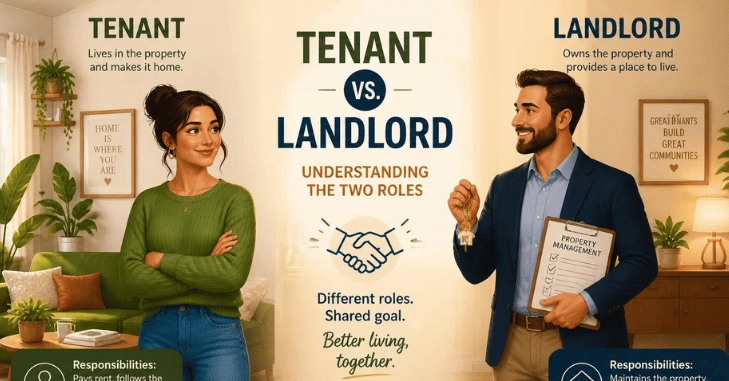
A tenant receives the right to use a property. A landlord provides that property and usually receives rent.Suppose Daniel owns a house and rents it to Maria. Daniel is the landlord, and Maria is the renter. Their lease states the amount due, the payment date, the rental period, and the rules both parties agree to follow.
In many rental arrangements, the person renting the property has duties such as:
- Paying rent on time.
- Following the agreed lease conditions.
- Taking reasonable care of the property.
- Reporting maintenance problems.
- Avoiding damage beyond normal wear.
The owner also has responsibilities that depend on the lease and applicable law. Rules about repairs, privacy, deposits, entry, and ending a tenancy differ between jurisdictions.
For more property terminology and ownership topics, see ReadsNow’s Real Estate section. Its property conveyancing guide for homebuyers also explains how legal ownership is transferred when property is bought rather than rented.
What Does the Word Mean in a Lease?
In a lease, the term typically identifies the person or organization that has the right to possess or use the property. The contract then lists what that party must do.
A rental agreement may cover:
- The property address.
- The length of the rental period.
- Monthly rent and payment dates.
- Security deposits.
- Utility responsibilities.
- Repair procedures.
- Rules for pets, guests, or subletting.
- Conditions for ending the agreement.
A lease is important because it records what the parties have agreed to. Legal definitions can differ by country, state, or type of property, so the contract should be read together with local law.
Readers looking for broader explanations of legal terminology can also browse ReadsNow’s Law section.
Residential and Commercial Examples
The word is not limited to apartments.
Residential example
A college student rents a room near campus for nine months. The student signs the rental agreement and pays monthly rent to the property owner.
Commercial example
A clothing company leases a store in a shopping center. The business pays rent to use the retail space and complies with the terms of its commercial lease.
Land example
A farmer may rent agricultural land from a landowner. Cambridge notes that the term can apply to people who pay for the use of land as well as buildings.
These examples show why context matters. The type of property may change, but the central idea remains the same: one party receives temporary rights to use property owned or controlled by another.
How to Pronounce and Spell the Word
The standard pronunciation is TEN-uhnt, written phonetically as /ˈten.ənt/. Cambridge gives closely matching British and American pronunciations.
The standard spelling is tenant.
Three commonly confused words are worth remembering:
- Tenant: someone who rents or occupies property.
- Tenet: a belief, principle, or doctrine.
- Tennant: usually a surname rather than the standard spelling of the word for a renter.
A simple memory trick is to connect “tenant” with “rent”. Both words relate to rental property.
Why the Definition Can Matter Legally
In everyday conversation, calling someone a renter may be enough. Legal disputes, however, can require a closer look at the person’s agreement and right to possess the property.
For example, questions may arise about whether someone is a renter, guest, licensee, subtenant, or occupant. Those categories may affect notice requirements, financial responsibility, and available legal protections.
The American Bar Association describes renters as people who do not own their housing but hold a contractual or other legal right to possession.
That is why you should avoid assuming that everyone staying in a home has identical rights. If a dispute involves eviction, deposits, repairs, or lease termination, check the agreement and the applicable rules for the property’s location.
The Bottom Line
Tenant meaning The word describes the person or organization on the renting side of a property arrangement. In everyday speech, renter usually means the same thing, while lessee is more common in formal agreements.
If you see the term in a lease, check the contract carefully. It tells you who has the right to use the property, who must pay rent, and which responsibilities apply. For more explanations covering homes, ownership, and property-related topics, explore ReadsNow’s property and real-estate explainers.
Frequently Asked Questions
It means a person or organization that rents property from another party. The property may be a house, apartment, office, shop, building, or land. Rent is commonly paid under a lease or rental agreement.
In everyday English, yes. Renter is the more casual term. Lessee is another close synonym and is more common in formal contracts.
The landlord provides the property for rent and normally owns or controls it. The renter receives permission to occupy or use the property and usually pays rent.
No. Someone may live in a rental property without being named on the lease. A child, partner, relative, or approved roommate may be an occupant without being a party to the main rental contract.
It is pronounced TEN-uhnt, with the stress on the first syllable. The IPA pronunciation is /ˈten.ənt/.
Yes. A company can rent offices, shops, warehouses, or other commercial properties. In that situation, the business is the party leasing the space.