
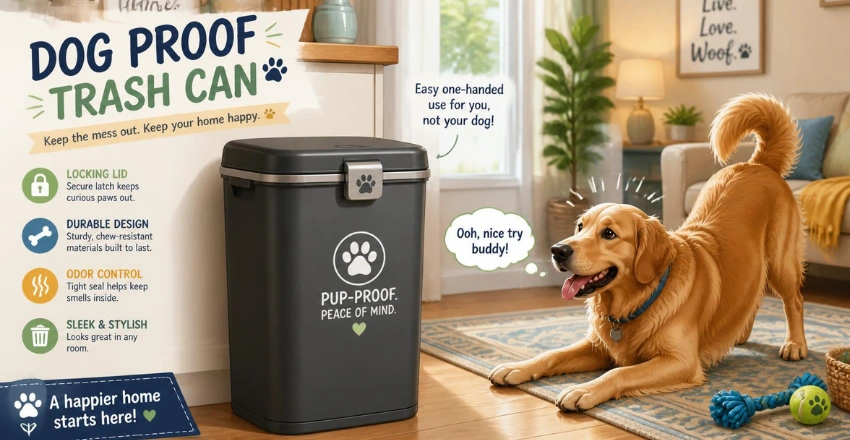
A dog-proof trash can solves more than an annoying kitchen mess. A determined dog can pull food scraps, bones, wrappers, medications, and other dangerous items from ordinary garbage, turning a tipped-over bin into a potential veterinary emergency. The best solution combines a lid your dog cannot operate with enough stability to prevent the entire container from being pushed or knocked over.
The challenge is that “dog-proof” does not describe one universal design. A small dog that noses open a bathroom wastebasket requires a different solution from a large, food-motivated dog that can work a foot pedal or tip over a lightweight kitchen can. This guide explains which locking systems work best, compares several current U.S. options, and shows how to make your existing trash setup more secure.
Short answer: A good dog-proof trash can should have a physical lid lock or pet-lock function, a stable base, durable construction, and a lid that limits access to food odors. For persistent dogs, a locked cabinet or closed room is even more secure because it removes access to the entire trash can rather than relying on the lid alone.
| Option | Capacity | Security feature | Best for | Main limitation |
|---|---|---|---|---|
| simplehuman Semi-Round Step Can | 13.2 gal | Physical slide lock | Best overall kitchen option | Lightweight compared with metal cans |
| iTouchless PetGuard Sensor Can | 13 gal | PetGuard lid lock | Hands-free kitchens | Requires batteries or optional adapter |
| iTouchless Wings-Open PetGuard | 13 gal | PetGuard lock | Low-clearance spaces | More moving/electronic parts |
| HANAMYA Slim Press-Top Bin | About 2.1 gal | Press-to-close lid | Bathrooms and offices | Not a true heavy-duty pet lock |
| Cabinet-secured trash setup | Varies | Cabinet door + secure latch | Persistent or large dogs | Requires space and setup |
Prices and availability can change, so treat any current price mentioned below as a September 2026 snapshot rather than a permanent price.
Best Dog-Proof Trash Can Options at a Glance
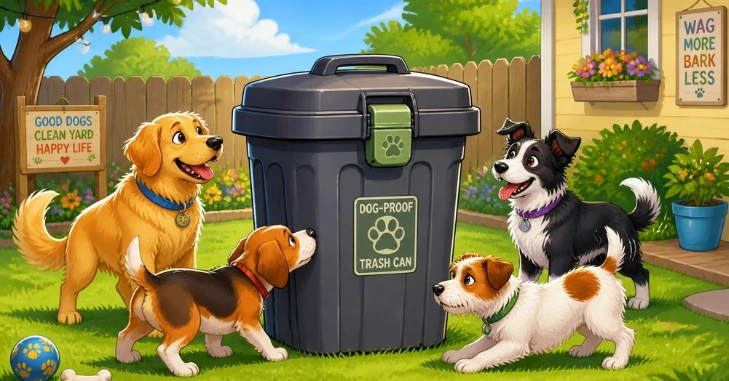
The strongest choices use an actual locking mechanism rather than simply placing a lid on top of the garbage. Physical slide locks are simple and reliable, while sensor cans can work well when they include a separate pet-lock control that turns off automatic opening. Press-top bathroom bins can deter some dogs, but don’t treat them as a true lock if you have a powerful or persistent pet.
1. Simplehuman 50L Semi-Round Step Can: Best Overall
For most kitchens, the simplehuman 50L semi-round model has one feature that matters more than decorative finishes or smart electronics: a physical slide lock. The 13.2-gallon can uses a step pedal for normal human access, but the separate lock secures the lid when you need to prevent pets from opening it. Target currently lists the black version at $49.99 and specifically describes the slide lock as a way to keep pets and curious children out.
The can weighs about 7.9 pounds, so its main weakness is not the lock itself but the possibility of a powerful dog pushing or tipping the body. Placement can therefore matter almost as much as the lid mechanism, especially with large breeds. Positioning the flat-backed can against a wall or between cabinets can reduce the room your dog has to attack it from multiple directions.
This model makes the most sense for owners who want a straightforward, dog-proof trash can without batteries, motion sensors, or a complicated locking sequence. The steel pedal and soft-close lid add everyday convenience, while the manual slide lock can be engaged before you leave the house or go to bed. It is also significantly less expensive than many electronic pet-lock models at current U.S. retail prices.
2. iTouchless 13-Gallon PetGuard: Best Touchless Option
The iTouchless 13-gallon sensor can is designed specifically to prevent pets from activating the automatic lid. Its infrared sensor gives people touch-free access, while the separate PetGuard lock can prevent the lid from opening when a dog or cat approaches the bin. The manufacturer also includes an activated-carbon odor filter and states that standard 13-gallon bags fit the can.
Current U.S. listings put versions of this model roughly in the $80-to-$90 range, although retailer prices and stock vary. It can run on four D batteries or an optional AC adapter, so owners should factor power into the long-term convenience calculation. The manufacturer lists dimensions of approximately 12.7 by 10.8 by 27.2 inches, making it relatively compact for a full-size kitchen bin.
The important feature is the PetGuard control, not the sensor itself. An ordinary motion-sensor bin may actually make trash easier for an observant dog to access if the animal learns what activates it. A sensor model deserves to be called pet-resistant only when you can disable or lock the opening mechanism when the dog is unsupervised.
3. iTouchless Wings-Open PetGuard: Best for Low Clearance
The wings-open version uses two lid panels rather than one tall lid, which can make it easier to position beneath counters or in spaces with limited overhead clearance. Walmart’s current listing describes a 13-gallon capacity, PetGuard lock, odor filter, stainless-steel body, and a wide opening for larger household waste. The same listing notes that the design can use batteries or an optional power adapter.
This style is useful when a traditional sensor lid would hit the underside of a countertop every time it opens. The locking function remains the feature dog owners should prioritize, because low clearance alone does nothing to prevent a nose or paw from activating an unlocked automatic lid. Owners should also consider whether they prefer a simple mechanical can or are comfortable maintaining another powered appliance in the kitchen.
For dogs that have already learned to operate step pedals, a locked sensor mechanism may be a worthwhile alternative. However, electronics add components that can eventually require maintenance, so durability and replacement-part availability deserve attention before you buy. A simpler slide-lock model can still be the better choice when maximum mechanical simplicity matters more than hands-free operation.
4. HANAMYA Slim Press-Top Bin: Best for Bathrooms
Bathroom garbage creates a different problem because you usually need a small container that fits beside a vanity, toilet, or narrow cabinet. HANAMYA sells a compact press-top bin made from PP and ABS plastic, with a closed design that hides the contents when the lid is shut. The manufacturer currently lists the small model at $35.95.
A press-top lid can be a meaningful upgrade over an open basket, especially for small dogs that simply nose through exposed trash. However, it is not the same as a heavy-duty locking lid, and a clever dog may eventually learn that pressure operates the mechanism. Owners of large dogs or determined scavengers should therefore use this style only in a bathroom that can also be closed off.
Bathroom waste can include tissues, personal-care products, dental items, medication packaging, and other objects you don’t want a pet chewing or swallowing. A compact closed bin reduces casual access, but placing it inside a cabinet or behind a closed bathroom door provides another layer of protection. For more general pet-related content, readers can also browse Readsnow’s Pets section.
5. A Locked Cabinet Is Often the Strongest Solution
Some dogs are too persistent for a freestanding trash can to be the only barrier. They may learn to use a pedal, push a bin over, nose at the lid, or repeatedly work on a latch until it fails. In that situation, putting the entire trash can inside a cabinet with a secure child-resistant latch creates two separate barriers instead of one.
The American Kennel Club recommends keeping garbage out of reach and specifically notes options such as child safety locks, gates, or placing bins behind a closed door. That approach is particularly useful when you regularly discard food waste with strong smells that keep attracting your dog even after training.
A secured cabinet also lets you use an ordinary inner wastebasket instead of buying the most expensive freestanding model. Make sure any freestanding cabinet or storage unit is stable and properly anchored so a large dog cannot tip it while trying to reach the contents. If you are reorganizing a garage or utility area at the same time, Readsnow’s heavy-duty garage shelving guide covers useful storage and anti-tipping considerations.
What Actually Makes a Trash Can Dog-Proof?
The lock is the first feature to evaluate because a lid that merely rests closed can often be lifted with a nose. Look for a mechanical slide lock, latch, pet-lock switch, or another mechanism that requires a deliberate human action your dog cannot easily reproduce. Magnetic closures, swing lids, and loosely fitted tops are generally less reassuring when the dog has already learned to raid garbage.
Stability comes next because a secure lid cannot protect the contents if the entire bin tips and the closure pops loose. A broad footprint, heavier construction, strategic placement against a wall, or enclosure inside cabinetry can make the can harder to overturn. Large dogs deserve special attention here because their body weight can defeat a lightweight bin without ever opening the lid normally.
Odor control helps because food smell is one reason household trash remains so attractive to dogs. Carbon filters and tight-fitting lids may reduce odors, but treat odor control as a secondary defense rather than a replacement for a real lock. A determined dog can still investigate a low-odor can if previous trash raids have taught it that food sometimes appears inside.
The final factor is human usability because an annoying lock eventually gets left unlocked. Choose a mechanism that everyone in the home can operate consistently during cooking, cleanup, and busy mornings. A slightly less sophisticated system that stays locked every day is more useful than an elaborate pet-proof feature nobody remembers to activate.
Why Keeping Dogs Out of Garbage Is a Safety Issue
The problem with household garbage is that dogs do not sort safe leftovers from dangerous ones. The ASPCA’s latest published toxin ranking for 2025 says food and drink accounted for 16.4% of calls to its Animal Poison Control Center, with grapes, raisins, xylitol-containing gum, onions, and garlic among the major exposures. Chocolate accounted for another 13.6% of reported exposures in that ranking.
Garbage can also contain cooked bones, packaging, plastic utensils, moldy food, coffee grounds, or other objects and substances that present risks. ASPCA guidance warns that bones may cause gastrointestinal injury or obstruction, while Pet Poison Helpline notes that moldy food can contain toxins that can cause gastrointestinal and neurological symptoms.
That is why a dog-proof trash can should be viewed as a preventive safety tool rather than simply a cleaner-looking kitchen accessory. If you believe your dog has swallowed toxic food, medication, a sharp object, a bone, or a substantial amount of unknown garbage, contact a veterinarian or animal poison service promptly instead of waiting for symptoms to develop. The appropriate response depends on what was eaten, how much was consumed, and the dog’s size and health.
How to Dog-Proof the Trash Can You Already Own
You may not need to replace your trash can immediately if the existing container is otherwise sturdy. The goal is to remove the specific weakness your dog is exploiting, whether that’s an unsecured lid, an exposed pedal, poor placement, or easy access to an entire room. Start by watching how the dog actually gets into the garbage rather than guessing.
Useful upgrades include:
- Add a suitable child-resistant latch if the lid design allows it.
- Move the trash can into a cabinet or pantry with a secure door.
- Put the bin behind a baby gate when the room layout allows it.
- Place the can where it can’t be easily tipped from the side.
- Keep especially attractive food waste in a separately secured container.
- Take out food-heavy trash before leaving the dog home alone.
- Keep compost and outdoor garbage, as well as indoor trash, inaccessible.
- Continue training cues such as “leave it” instead of relying entirely on hardware.
Training and physical management work best together because the trash can is an environmental temptation you can control. Even a well-trained dog may investigate an unusually strong smell when nobody is watching, while a secure barrier prevents one impulsive decision from becoming a dangerous meal. Readsnow’s broader Home Improvement section can also help when you are reorganizing kitchens, garages, or utility spaces around pets.
Match the Trash Can to Your Dog
For a small dog that mainly investigates open bathroom bins, a press-top container placed in a restricted room may be sufficient. For a medium dog that noses up ordinary kitchen lids, a physical slide-lock can is a stronger and simpler upgrade. For a clever dog that operates pedals, prioritize a separate lock that stays engaged no matter what happens to the opening mechanism.
Large dogs introduce the additional problem of force and leverage. Even a good lid lock may fail as a complete system if a 70-pound dog can knock the container across the kitchen, so weight, base width, and placement matter more. A secured cabinet or closed pantry is usually the more dependable option when you already know your dog can overpower freestanding bins.
Plan multi-dog homes around the most capable trash raider, not the least interested pet. One dog may discover how the mechanism works and create access for everyone else. Designing the setup for the strongest, tallest, or most persistent dog gives you a larger safety margin.
Features You Can Usually Skip
A stainless-steel body can look better and resist chewing or scratching, but stainless steel alone does not make a trash can pet-proof. A dog that can open the lid does not care whether the sides are polished metal or plastic. Prioritize the locking mechanism and stability, then consider finish and appearance.
Automatic opening is a convenience feature, not a security feature. If you want a sensor can, choose one with a separate pet lock that prevents the sensor from granting access while you are away. Without that additional control, the technology may solve your hands-free problem while doing little to solve your dog problem.
Odor filters are useful for kitchen comfort and may reduce one source of temptation, but they should not carry the security burden. Dogs have an exceptional ability to investigate food smells, and complete odor elimination is unrealistic in a household garbage container. Treat filtration as a bonus after you have solved locking and tipping.
The Bottom Line
The best dog-proof trash can defeats the way your individual dog attacks the garbage. For most kitchens, that means starting with a physical locking lid, such as the Simplehuman slide-lock design or a PetGuard-equipped iTouchless model. Improve placement so the can can’t be tipped; press-top cans can work in bathrooms, but persistent dogs deserve stronger barriers.
Don’t rely on Don’tDon’ting, odor control, a foot pedal, or a heavy-looking stainless-steel body alone. Combine a reliable lock with restricted access, and move the entire bin behind a latched cabinet or closed door if your dog continues defeating freestanding containers. That setup keeps your floor cleaner, but more importantly, it reduces access to foods, bones, medications, packaging, and other garbage that can harm your dog.
Frequently Asked Questions
What is the best dog-proof trash can?
For most households, a kitchen trash can with a physical lid lock is the strongest starting point because it is simple and easy to verify before leaving the dog alone. The Simplehuman 50L semi-round model is a practical current example because its slide lock is specifically designed to keep pets and children out. Larger or exceptionally persistent dogs may still require you to place the entire bin inside a locked cabinet.
Can dogs open step trash cans?
Yes, some dogs can learn that pressing or leaning on a pedal opens the lid. The risk depends on the dog’s size, persistence, and previous experience with the bin, so a pedal shouldn’t be cshouldn’tshouldn’t a security feature on its own. If your dog understands the pedal, use a separate physical lock or move the trash behind a cabinet door.
Are motion-sensor trash cans dog-proof?
A standard motion-sensor trash can isn’t automatically dog-proof because a pet’s movement triggers the sensor. Models with a separate pet-lock mode are more suitable because the sensor can be disabled or prevented from opening the lid. Always verify how the specific locking feature works before relying on it while your dog is unsupervised.
How can I keep a large dog from tipping over the trash can?
Start with a broad, stable can and place it where the dog has limited room to push from the side. For a dog that can overpower freestanding containers, move the bin into an anchored cabinet, pantry, or utility space behind a securely latched door. Preventing access to the container itself is generally more reliable than adding more weight to a bin the dog can still reach.
Why does my dog keep getting into the garbage?
Garbage contains concentrated food odors and occasionally rewarding leftovers so that a successful trash raid can reinforce the behavior. Boredom, opportunity, hunger, and learned scavenging habits can all contribute, but the exact reason varies from dog to dog. The practical response is to remove access while also training and establishing an appropriate daily routine.
What should I do if my dog ate something from the trash?
Identify what your dog may have swallowed and contact your veterinarian promptly when the item could be toxic, sharp, obstructive, moldy, or otherwise dangerous. Foods such as chocolate, grapes, raisins, onions, garlic, and products containing xylitol are among the hazards pet owners should keep away from dogs. Do not induce vomiting or try a home treatment unless a veterinarian or qualified poison professional specifically instructs you to do so.
—–