

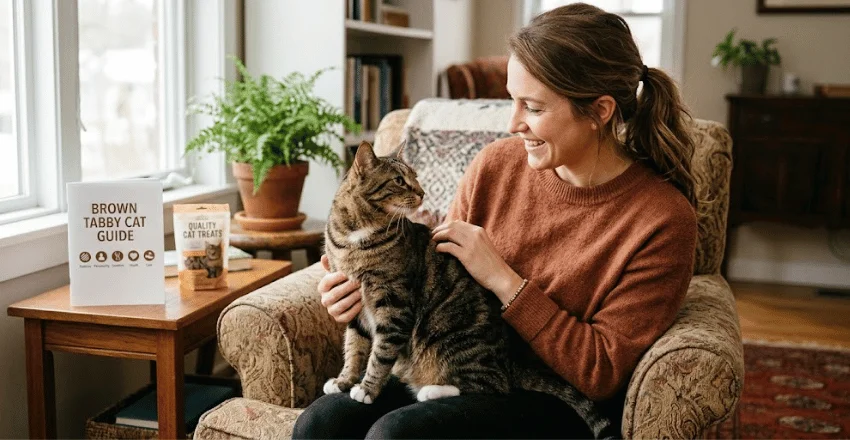
A brown tabby cat has warm brown fur with darker tabby markings, including stripes, swirls, spots, or banded hairs. The label describes coat color and pattern, not a single breed. That distinction explains why two brown tabbies can differ greatly in size, behavior, grooming needs, and health.
Direct answer: A brown tabby is not a breed. It is a brown coat color combined with a tabby pattern. These cats can belong to many breeds or mixed backgrounds, so care needs depend on each individual cat. Personality also comes from genetics, socialization, health, and life experience.
Key Facts at a Glance
| Category | What to know |
|---|---|
| Meaning | Brown describes color, while tabby describes a coat pattern. |
| Breed status | Brown tabbies can be mixed-breed or pedigreed cats. |
| Common markings | Facial lines, an M-shaped forehead marking, leg bars, and tail rings often appear. |
| Main patterns | Mackerel, classic, spotted, and ticked are widely recognized. |
| Personality | Coat pattern does not reliably predict temperament. |
| Health | Pattern alone does not create a special disease profile or lifespan. |
| Care | Grooming depends mainly on coat length, age, health, and lifestyle. |
Key Takeaways
- Tabby describes markings rather than breed identity.
- Brown tabbies can have stripes, swirls, spots, or ticked hairs.
- Genetics shapes coat pattern, but it doesn’t determine personality.
- Health and lifespan depend more on ancestry, lifestyle, and veterinary care.
- Short coats usually need less brushing than long coats.
- Indoor safety, balanced nutrition, enrichment, and routine veterinary care matter for every cat.
1. Brown Tabby Cat Is a Color-Pattern Description, Not a Breed
The Cat Fanciers’ Association separates a cat’s identity into color, pattern, and breed. A brown tabby may be a Domestic Shorthair, Maine Coon, American Shorthair, or another type. Mixed-breed cats can wear the same markings without sharing close ancestry.
CFA describes brown tabbies as having a warm brown or bronze background with black markings. Common facial details include eye lines and the familiar M-shaped forehead marking. Legs and tails often show bars or rings that make the pattern easier to recognize.
2. The Coat Can Show Several Tabby Patterns
Mackerel tabbies have narrow stripes that usually run vertically along the body. Classic tabbies show broader curves, whorls, or a blotched pattern. Spotted tabbies break the darker markings into spots rather than continuous stripes.
Ticked coats look more even because individual hairs carry alternating color bands. Strong stripes may still appear on the face, legs, or tail. Some registries also recognize patched tabbies, which combine tabby markings with red or cream patches.
| Pattern | What you usually see | Easy identification clue |
|---|---|---|
| Mackerel | Narrow vertical stripes | A tiger-like striped body |
| Classic | Broad swirls and curves | Large side whorls or blotches |
| Spotted | Distinct spots | Broken markings across the body |
| Ticked | Banded hairs with fewer body stripes | More even body color with facial striping |
| Patched | Tabby pattern plus red or cream patches | Mixed tabby and tortoiseshell coloring |
3. Genetics: Build the Markings Before the Adult Coat Appears
Research has linked tabby pattern variation to several genes involved in coat development. The TAQPEP gene helps influence mackerel and blotched pattern differences. Later research identified DKK4 as another gene affecting how pattern elements form.
Scientists have also found that pattern development begins before mature hairs grow. Early fetal skin already shows molecular differences connected with future markings. The adult coat reflects a developmental program established long before a kitten looks fully striped.
Brown coloring also involves how pigment appears within individual hairs. Agouti banding creates alternating lighter and darker regions along many hairs. Darker solid hairs then form the visible stripes, swirls, spots, or other markings.
4. Brown Tabbies Are Common Rather Than a Rare Breed
Brown tabbies are frequently seen in shelters, homes, and pedigreed cat populations. Their familiar appearance reflects an old coat pattern found across domestic cat ancestry. An ancient-DNA study found that the blotched pattern became common later than the ancestral striped form.
That history helps explain why a striped brown coat can look close to a wildcat pattern. Early domestic cats retained markings similar to their wild ancestors. Selective breeding later expanded the coat colors and pattern shapes seen today.
A common coat does not make an individual cat ordinary. Eye color, white patches, coat length, pattern clarity, body type, and ancestry can create major visual differences. Two cats labeled brown tabby may look quite different side by side.
5. Personality Comes From the Individual Cat
People often describe tabbies as friendly, playful, bold, or affectionate. Those descriptions can fit many cats, but coat pattern does not reliably predict temperament. Breed background, early socialization, health, learning, and home environment have greater influence.
This matters when you adopt a cat based on appearance. Watch how the cat reacts to handling, noise, play, food, strangers, and other animals. Shelter or foster observations can also reveal behavior that coat color cannot predict.
A shy cat may become warmer after settling into a predictable home. An outgoing kitten can also change as it matures. Treat temperament as an individual trait, not a promise attached to stripes.
6. Health and Lifespan Depend on More Than Coat Color
A cat doesn’t have a separate disease profile just because it has brown tabby markings. Health risks relate more closely to ancestry, genetics, age, body condition, environment, and preventive care. A pedigreed cat may need screening for breed-associated conditions.
The same principle applies to lifespan. Brown coloring does not determine a specific lifespan for these cats. Indoor safety, healthy weight, dental care, parasite control, vaccinations, and veterinary monitoring can support long-term well-being.
Routine examinations should match the cat’s age, lifestyle, and medical history. Feline guidance supports annual or semiannual exams, with the more frequent schedule recommended for seniors. Your veterinarian can adjust prevention based on individual exposure and health risks.
7. Everyday Care Should Match Coat Length and Lifestyle
Short-haired tabbies often need modest grooming because cats clean much of their own coat. Regular brushing removes loose hair, dirt, and small tangles. The ASPCA suggests one or two brushing sessions weekly for many cats.
Long-haired cats need more frequent grooming because mats can form near the legs, belly, ears, and rear. The ASPCA advises grooming long-haired indoor cats every few days. Short, calm sessions usually work better than forcing one long grooming period.
Nutrition should also match life stage, body condition, activity, and health. Cats need complete nutrition with enough animal-based nutrients, including taurine. Fresh water should remain available every day.
Indoor cats still need movement, play, scratching choices, hiding areas, climbing opportunities, and mental stimulation. A predictable environment supports normal feline behavior and reduces avoidable risks. ReadsNow’s Home Improvement section can provide storage and layout ideas for shared pet spaces.
How to Identify One at Home

Start with the background color before studying the markings. A brown tabby usually has warm brown or bronze tones beneath darker markings. Gray or silver cats have a cooler background, even when their stripes look nearly black.
Next, check the face, legs, belly, and tail for repeated pattern clues. The forehead M is common, but it does not identify breed ancestry. Tail rings and leg bars often make a faint body pattern easier to classify.
Finally, compare the body pattern with mackerel, classic, spotted, or ticked examples. Long fur can soften the appearance of stripes and swirls. A veterinarian or experienced rescue worker can help when color, pattern, and breed labels seem confusing.
Living With a Brown Tabby in a U.S. Home
For most owners, daily needs match those of any healthy domestic cat. Keep litter boxes clean, provide fresh water, offer scratching surfaces, and schedule interactive play. Food portions should reflect body condition, not assumptions about coat type.
Household safety matters because curious cats can reach plants, string, medication, chemicals, and open trash. Secure toxic foods, small swallowable objects, and unstable furniture. ReadsNow’s dog-proof trash can guide also offers useful garbage-control ideas for multi-pet homes.
If you are adopting, ask about medical records, vaccination history, microchip status, diet, litter habits, and observed behavior. Those details tell you more than coat pattern alone. They also make the first weeks at home more predictable for both you and the cat.
Frequently Asked Questions
Are these cats rare?
No, brown tabbies are commonly seen among mixed-breed and pedigreed cats. The color-pattern combination is not treated as a rare breed category. Rarity can still vary within particular pedigreed breeds or unusual genetic combinations.
What breed is a brown tabby cat?
A brown tabby can belong to many breeds or have no pedigree breed at all. The term describes color and pattern, not ancestry. Breed identification requires more evidence than stripes, forehead markings, or coat color.
Can males and females both have this coloring?
Yes, both males and females can have brown tabby coloring. It lacks the strong sex association seen with some orange or tortoiseshell patterns. Patched tabbies with red or cream areas are more strongly associated with female cats.
Do brown tabbies have a special personality?
No reliable personality type belongs to all brown tabbies. Individual behavior depends on genetics, breed background, socialization, health, experience, and environment. Meet the cat and judge temperament from observed behavior instead of coat stereotypes.
How long do these cats live?
This coat pattern has no separate lifespan. Longevity depends more on individual health, ancestry, lifestyle, nutrition, and veterinary care. Ask your veterinarian about age-specific prevention instead of using coat color to estimate lifespan.
A Better Way to Think About Brown Tabbies
This familiar coat description can appear across many breeds and mixed backgrounds. The markings can teach you about pattern genetics, but they cannot tell you everything. Breed, personality, health, and care still need individual evaluation.
If you are bringing one home, review its medical records and prepare a safe indoor space first. Then schedule veterinary care and build a routine around food, play, grooming, and litter. For more everyday guidance, browse ReadsNow’s Pets section.