

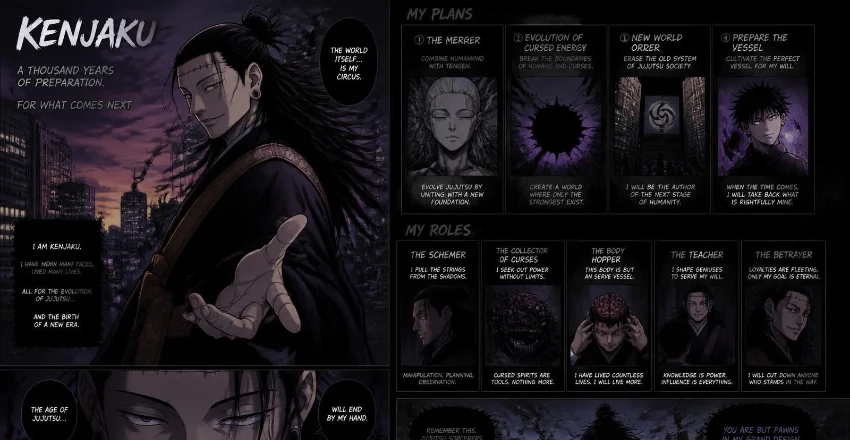
Spoiler warning: This article contains major Jujutsu Kaisen manga spoilers, including events beyond the Shibuya Incident anime storyline. Anime-only viewers should stop before the later-story sections if they want to avoid major reveals. The discussion covers the character’s identity, hosts, abilities, Culling Game plan, and fate.
The mysterious figure wearing Suguru Geto’s face is one of Jujutsu Kaisen’s most important antagonists. Kenjaku is an ancient sorcerer who survives by transferring into other bodies. This ability lets the villain manipulate jujutsu society across different eras while pursuing a centuries-long experiment.
| Quick fact | Answer |
| Series | Jujutsu Kaisen |
| Role | Major antagonist and ancient curse user |
| Current well-known host | Suguru Geto |
| Other known hosts | Noritoshi Kamo and Kaori Itadori |
| Defining ability | Transferring into and controlling other bodies |
| Geto’s body’s key technique | Cursed Spirit Manipulation |
| Major schemes | Shibuya Incident and Culling Game |
| Connection to Yuji | Occupied the body of Yuji’s mother |
| Manga name reveal | Chapter 145 |
Direct answer: Kenjaku is an ancient curse user who extends life by moving into other people’s bodies. The character uses Suguru Geto’s corpse during much of the main story. That body gives the villain access to Geto’s Cursed Spirit Manipulation and makes several major plans possible.
Who Is Kenjaku in Jujutsu Kaisen?
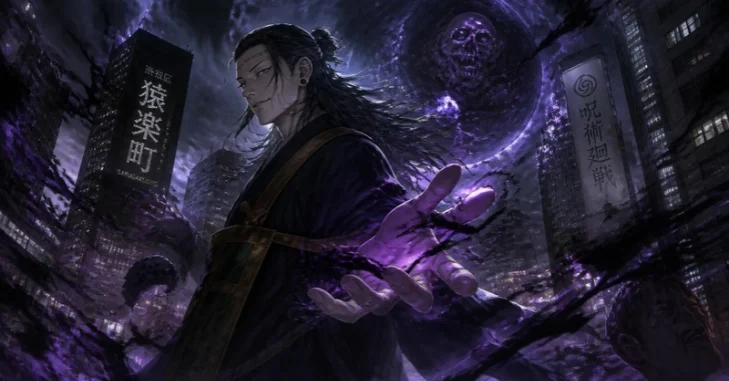
The Kenjaku character is not Suguru Geto resurrected, despite sharing Geto’s appearance for much of the series. The real Geto died after the events depicted in Jujutsu Kaisen 0. An ancient sorcerer later took possession of his body and used it as a host.
This distinction explains one of the biggest mysteries surrounding Geto during the main storyline. Satoru Gojo knows his former friend should be dead, yet someone with Geto’s body appears in Shibuya. The imposter eventually reveals the unusual brain inside the body’s stitched skull.
The anime eventually makes the ancient sorcerer’s separate identity clear. That distinction matters because Geto and his body’s later occupant have different histories and motivations. Readers interested in similar film, television, and character stories can explore ReadSnow’s broader entertainment coverage.
Is Kenjaku the Same Person as Suguru Geto?
No, Suguru Geto and the sorcerer controlling his corpse are separate characters. Geto was Gojo’s former friend and a powerful user of Cursed Spirit Manipulation. His personal history and eventual death occur before his body becomes part of the larger scheme.
The possession creates confusion because Geto’s body retains its appearance and useful abilities. Even Gojo’s Six Eyes identifies the body as Geto during their confrontation. Gojo recognizes the deception because he personally knows what happened to his former friend.
This difference also changes how viewers should interpret the villain’s actions during Shibuya. Those schemes do not represent Geto secretly returning to continue his earlier plans. They belong to another sorcerer who selected Geto’s corpse for its strategic value.
The Known Bodies Used Across History
Body transfer gives the ancient curse user something more valuable than ordinary longevity. Each new identity can provide social access, useful relationships, and powerful cursed techniques. The known hosts also connect several mysteries that initially seem unrelated.
Noritoshi Kamo
One important former identity was Noritoshi Kamo, a notorious figure from the Kamo family. This is not the younger Kyoto student who carries the same name. The historical Kamo became associated with the experiments that produced the Cursed Womb: Death Paintings.
That history directly connects the ancient sorcerer to Choso and his siblings. It also helps explain why Choso becomes crucial to uncovering the truth. What first appears to be separate family history eventually becomes part of the antagonist’s much longer experiment.
Kaori Itadori
Another major reveal concerns Kaori Itadori, the wife of Jin Itadori and mother of Yuji. Manga revelations show the familiar forehead stitches on her body. The implication becomes crucial for understanding Yuji’s unusual family background.
This means Yuji’s connection to the central conspiracy predates his decision to consume Sukuna’s finger. His birth is tied directly to a sorcerer who had been experimenting for centuries. That connection also helps explain why Yuji and Choso share an unusual familial link.
Suguru Geto
Geto becomes an exceptionally valuable host because of his innate Cursed Spirit Manipulation technique. After Geto’s death, his body was left available for possession. The new occupant could then use Geto’s appearance, abilities, and relationships.
That choice creates a major tactical advantage against Gojo during the Shibuya Incident. Seeing his deceased best friend produces the hesitation needed for the Prison Realm strategy. The body therefore functions as both a powerful weapon and a psychological tool.
Kenjaku’s Powers and Cursed Techniques Explained
Body transfer is the foundation of the villain’s extraordinary longevity. The technique allows the sorcerer to place their brain into another body and control that host. A stitched scar around the forehead becomes the most recognizable physical sign of possession.
Possession can also provide access to techniques associated with a host body. Geto’s Cursed Spirit Manipulation is the most important example during the main storyline. It allows captured cursed spirits to be controlled and deployed for different purposes.
The manga also establishes a connection to Kaori Itadori’s Antigravity System technique. This makes the antagonist difficult to evaluate using a single fixed power set. Centuries of knowledge and preparation matter alongside raw cursed energy and combat ability.
The character’s greatest weapon may still be planning rather than direct fighting strength. The Shibuya operation depends on understanding Gojo, Geto, the Prison Realm, and other participants. Later schemes similarly rely on barriers, binding vows, reincarnated sorcerers, and carefully prepared conditions.
Why Did the Villain Take Geto’s Body?
Geto’s technique offered an unusual opportunity because it could control cursed spirits. That ability became especially valuable once Mahito entered the antagonist’s plans. Mahito possessed Idle Transfiguration, a technique central to preparing people for the Culling Game.
Geto’s identity also provided practical advantages among practicing jujutsu sorcerers. His appearance had emotional significance for Gojo and credibility among powerful cursed spirits. The host therefore solved several strategic problems at once.
Most importantly, Geto’s face helped create the conditions for sealing Gojo. The plan did not require defeating the strongest sorcerer through conventional combat. Instead, it exploited Gojo’s memories and the Prison Realm’s unusual activation requirements.
What Was the Plan Behind the Culling Game?
The Culling Game was not created as a simple tournament for deciding who was strongest. It formed part of a much larger experiment involving cursed energy and human evolution. Participants and colonies supplied the conditions needed for the next stage of that experiment.
The villain had prepared people for participation before the game fully began. Some received cursed techniques, while historical sorcerers returned through vessels connected to previous arrangements. This transformed Japan into the setting for an enormous controlled conflict.
A central objective involved Master Tengen and the possibility of merging Tengen with people across Japan. Tengen’s unusual evolved state made this plan possible within the story’s jujutsu rules. The resulting transformation could produce consequences beyond anything the antagonist could fully predict.
That uncertainty is essential to the character’s motivation. The goal is not simply conventional political control or personal wealth. The villain repeatedly pursues possibilities created when cursed energy pushes humanity beyond familiar limits.
How Is Yuji Itadori Connected to the Ancient Sorcerer?
Yuji’s connection is biological because the antagonist previously occupied Kaori Itadori’s body. Kaori was married to Jin Itadori and became Yuji’s mother. The forehead stitches shown in the manga identify the possession that makes this relationship possible.
The revelation also reframes Yuji’s relationship with Choso. Choso originated from the Death Painting experiments associated with the historical Noritoshi Kamo identity. Both characters therefore have a family connection through different bodies controlled by the same individual.
Still, not every mystery surrounding Yuji receives a simple answer from this fact alone. His physical abilities and relationship with Sukuna involve additional story developments. Readers should separate confirmed connections from theories that extend beyond the manga’s explicit revelations.
Role in the Shibuya Incident
The Shibuya Incident demonstrates how dangerous careful preparation can become in Jujutsu Kaisen. The antagonists create conditions that isolate Gojo and force him to respond inside a crowded underground station. The operation is designed around his abilities rather than relying on greater fighting power.
Geto’s body then becomes the final psychological component of the trap. Gojo’s reaction gives the Prison Realm the opening needed to complete its activation conditions. Removing Gojo dramatically changes the balance of power for everyone remaining in Shibuya.
The scheme continues after Gojo’s sealing rather than ending with that victory. Mahito eventually becomes another resource in the larger plan. These events lead directly toward the conditions that make the Culling Game possible.
Anime fans often follow stories across several devices and services. Readers comparing digital viewing options can also read ReadSnow’s Fandango at Home guide for an explanation of rentals, purchases, and streaming features.
What Happens to Kenjaku? Major Manga Spoilers
Major manga spoilers begin here. During the later Culling Game storyline, Fumihiko Takaba confronts the ancient sorcerer. Takaba’s unusual technique turns their encounter into one of the series’ strangest battles.
Yuta Okkotsu uses the opportunity created by that confrontation to attack. He successfully decapitates the antagonist after Takaba’s battle creates the necessary opening. Yet the villain had already prepared measures that allowed the broader merger plan to remain relevant.
The development fits the character’s established approach to conflict. Plans are designed so that one individual’s survival is not always the only condition for success. That preparation keeps earlier schemes important even after the direct confrontation ends.
Why This Villain Matters So Much to Jujutsu Kaisen
Many major events in the series connect back to this character’s actions across different identities. The Death Paintings, Yuji’s birth, Gojo’s sealing, and the Culling Game all intersect with those plans. Few characters connect as many separate generations of the story.
The body-swapping technique also reinforces one of Jujutsu Kaisen’s recurring questions about identity. Geto’s body looks authentic and retains abilities associated with him, yet another consciousness controls it. The series repeatedly asks whether identity rests in the body, soul, memories, or something harder to define.
This theme becomes especially striking during Gojo’s confrontation with the possessed Geto body. Gojo intellectually knows his friend is dead despite what his powerful eyes perceive. The conflict between physical evidence and personal recognition makes the reveal more than a standard disguise twist.
Fans who watch anime, stream entertainment, and play games often care about their home audio setup too. ReadSnow’s PlayStation earbuds review covers sound quality, comfort, compatibility, and long-session performance.
Final Takeaway
Understanding this antagonist makes several complicated parts of Jujutsu Kaisen easier to connect. Geto’s apparent return, Choso’s family history, Yuji’s parentage, Shibuya, and the Culling Game belong to one much larger chain. The body-transfer ability allows that chain to stretch across generations.
The character works because power alone is never the entire threat. Patience, experimentation, stolen identities, and long-term planning shape nearly every major move. Together, those qualities make the ancient sorcerer central to understanding the conflicts that drive Jujutsu Kaisen.
Frequently Asked Questions
Who is Kenjaku in Jujutsu Kaisen?
Kenjaku is an ancient curse user who can transfer into other bodies and control them. The character occupies Suguru Geto’s corpse through much of the main storyline. Earlier hosts include historical Noritoshi Kamo and Kaori Itadori.
Is Geto still alive?
Suguru Geto himself did not secretly return after the events surrounding Jujutsu Kaisen 0. Another sorcerer later took control of his corpse. The person operating Geto’s body in the main story is therefore not the original Geto.
Why does Geto have stitches on his forehead?
The stitches indicate the procedure associated with the body-transfer technique. They circle the upper portion of the host’s head where the brain has been transplanted. Similar markings become an important clue when other possessed bodies are revealed.
Is the ancient sorcerer Yuji’s mother?
The precise answer requires an important distinction. The sorcerer occupied Kaori Itadori’s body, and Kaori’s body gave birth to Yuji. This makes the antagonist directly connected to Yuji’s parentage without making Kaori and her possessor the same individual.
Why was Suguru Geto’s body so useful?
Geto possessed Cursed Spirit Manipulation, which gave his body’s new occupant access to an exceptionally useful technique. His appearance also created a psychological advantage against Gojo. Together, those factors made Geto’s corpse strategically valuable.
What is the character’s ultimate goal?
The broad objective centers on pushing cursed energy and human evolution into an unpredictable new state. The Culling Game and planned merger involving Tengen are major parts of that experiment. This motivation separates the villain from characters seeking simple conquest or destruction.