


Hiring an email marketing agency is mostly a pricing and trust problem, not a technical one. Plenty of shops will send campaigns for you. Far fewer will grow the revenue from customers you already paid to acquire. This guide covers what you’ll pay, who’s worth paying, and how to spot the difference before you sign.
Short answer: most US shops charge $2,500 to $10,000 a month to run a managed email and SMS program. Small production teams start near $1,500. Enterprise programs push past $18,000. Choose based on the depth of the retention work and the account manager’s client load, not on the price at the front of the deck.
The numbers at a glance
Here is the shape of the US market in 2026, drawn from current agency pricing pages, directory listings and the quotes brands report receiving.
| Question | What the market says |
|---|---|
| Typical monthly retainer | $2,500 to $10,000 for a managed program |
| Entry-level production work | $1,500 to $2,500 a month |
| Enterprise programs | $12,000 to $18,000 and up |
| Usual starting commitment | 90 days, then rolling |
| First visible wins | 30 to 60 days |
| Full revenue impact | 90 to 120 days |
| Email and SMS share of e-commerce revenue to target | 25% to 40% |
| Platforms you’ll hear about | Klaviyo, Mailchimp, HubSpot and Braze |
TL;DR: You’re paying for retention thinking, not for send volume.
- Budget $3,000 to $5,000 a month for a serious program at a mid-sized e-commerce brand.
- Ask how many clients each account manager carries. Two to five is healthy. Ten is a queue.
- Expect quick wins in 30 to 60 days and real revenue movement at 90 to 120 days.
- Get deliverability scope, data ownership, and the notice period in writing before month one starts.
What an email marketing agency actually does
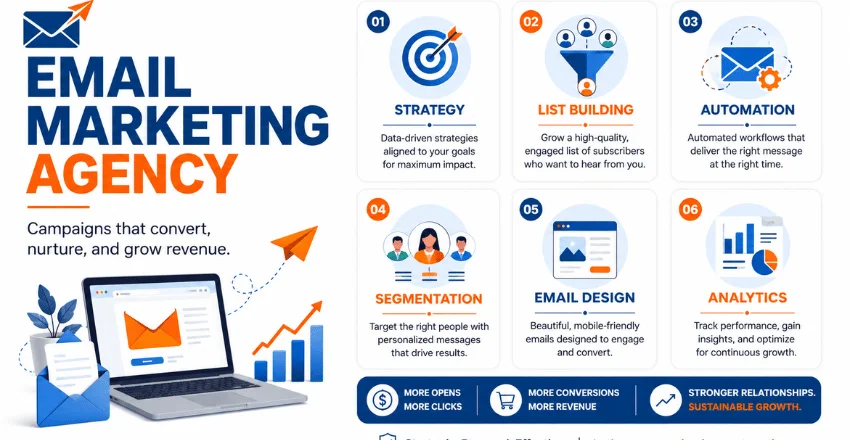
The job splits four ways: strategy, production, technical health, and reporting. Strategy decides who gets which message and when. Production writes and builds it. Technical health keeps your mail landing in the inbox rather than the spam folder, which is the part most buyers forget to ask about.
Reporting is where weak teams get lazy. A strong partner shows you revenue per recipient, list growth, and flow performance by segment. Not a screenshot of open rates. Lifecycle work looks a lot like funnel work, which is why the same tools that streamline demand generation keep showing up in an agency’s stack. Welcome series, browse and cart flows, win-back sequences, and post-purchase upsells: that’s nurture with a shorter path to checkout.
Four types of agency, compared
They are not interchangeable. Price tracks scope, and scope tracks how much of the channel the team will own.
| Agency type | Typical monthly fee | Strengths | Weak spots |
|---|---|---|---|
| Freelancer or two-person studio | $800 to $2,000 | Cheap, fast, direct access to the person doing the work | No cover for sickness or vacation, thin design and deliverability skills |
| Production shop | $1,500 to $3,000 | Reliable build and send, solid templates, quick turnaround | Executes your plan, will not write the strategy |
| Retention specialist | $3,000 to $10,000 | Owns flows, segmentation, deliverability, and testing | Ecommerce first, less useful for long B2B nurture |
| Full-service digital agency | $5,000 to $18,000 and up | One team across paid, SEO, content and email | Email becomes a side dish behind the paid media budget |
Most mid-sized brands land on the retention specialist. Choose a production shop when you already have a strategist in-house and need hands, not opinions.
What each budget buys
Agencies price three ways: a monthly retainer, a project fee, or a hybrid that adds a small share of attributed revenue on top of a base fee. Retainers dominate because they’re predictable for both sides. Pure performance deals stay rare for a good reason. Attribution across email, paid, and organic gets messy fast, and nobody enjoys arguing about it every month.
- $1,500 a month. The campaign builds and sends against a calendar you supply. Little strategy.
- $3,000 a month. Four to six campaigns, two or three core flows built or rebuilt, monthly reporting.
- $5,000 a month. Full calendar, SMS, ongoing testing, deliverability monitoring, a named strategist on the account.
- $10,000 and up. A pod of four or five people, custom design, advanced segmentation, and quarterly planning sessions.
Ask what happens when you need an extra campaign during a big sales week. Some teams bill it. Others fold it in, and that answer tells you how the relationship will feel in month six.
Agency or in-house? Run the numbers
Most guides wave at this comparison. Here it is with figures.
| Line item | First year in-house | Agency at $5,000 a month |
|---|---|---|
| Pay for two people | $150,000 to $260,000 | Included |
| Benefits and payroll costs | $30,000 to $60,000 | Included |
| Software and tooling | $6,000 to $30,000 | Usually still yours |
| Recruiting and ramp-up time | $15,000 to $50,000 | None |
| Year one total | $200,000 to $400,000 | $60,000 |
The math favors the agency until your workload is steady enough to keep someone busy every week of the year. That’s the real trigger for hiring in-house, not headcount or company size.
Plenty of brands run both. One in-house owner sets the strategy and holds the agency to it, which is the cheapest quality control you can buy.
Where email sits next to your other channels
Email does not create demand. It converts and keeps the demand your other channels bought. If traffic is flat, an agency will spend its first quarter squeezing a small list, and the reported gains will look small too.
So sort acquisition first. Our comparison of choosing between SEO and PPC pairs well with this decision, because the answer sets how fast your list grows. For e-commerce, aim for email and SMS to carry 25% to 40% of total revenue once the program matures.
Seven tests before you sign

Run every candidate through the same seven. Score them out of seven, and the shortlist writes itself.
- Client load. Ask how many accounts each account manager carries. Two to five is workable. Ten or more means you’re sitting in a queue.
- Case studies with numbers. Revenue per recipient, flow revenue, list growth. Screenshots of open rates don’t count.
- Deliverability process. They should raise list suppression, domain warming, and authentication records without being prompted.
- A named process. Ask them to walk you through weeks one to four. Vague answers here predict vague reporting later.
- Industry samples. Ask for two campaigns they built for a brand like yours, plus one that flopped and what they changed.
- The contract. Check the notice period, who owns the data and the creative, and who keeps the Klaviyo or Mailchimp account when you leave. Thirty days’ notice is normal. Twelve-month lock-ins are not.
- Reporting and attribution. Ask which attribution model and lookback window they report on, then ask to see a real client report with the names removed.
Those evaluation habits travel across disciplines. This look at what makes a specialist design agency stand out lands on the same two tests: portfolio depth and a process someone can name out loud.
Red flags that should end the conversation
Three of these on one call are plenty. Move on.
- A promise of specific revenue. Nobody controls the number they’re promising.
- Pricing they won’t put in writing until the third call.
- Account managers carrying ten or more clients each.
- Template-only work, with no custom design anywhere in the portfolio.
- No answer on deliverability beyond “We use a good platform.”
- Reporting built on last-click attribution with a long lookback window, which inflates the revenue the email appears to drive.
Revenue guarantees are the loudest signal of the lot. Ask how they calculate the reported figure and whether the paid media team counts the same order in its own dashboard. Double counting is common, and it flatters everybody except you.
What the first 90 days should look like
Ask for this plan in writing before you sign. If nobody can produce one, there is no process behind the pitch.
| Period | What lands | What to measure |
|---|---|---|
| Month one | Audit, list cleanup and suppression, SPF, DKIM, and DMARC records checked, domain warming, welcome flow live | Inbox placement, bounce rate |
| Month two | Two to four more flows, first full campaign calendar, segmentation rebuilt, and the first A/B tests | Revenue per recipient, click rate |
| Month three | Steady testing cadence, SMS layered in, a quarterly plan for the next 90 days | Email share of total revenue |
Quick wins land in the first 30 to 60 days. Real revenue movement takes 90 to 120 days. Anyone promising more inside month one is selling, not planning.
The verdict: who should hire, and who shouldn’t

Our recommendation: hire a retention specialist at $3,000 to $5,000 a month. That fits once your list passes 10,000 and monthly revenue clears $100,000. Below that, a production shop or a sharp freelancer at $1,500 does more per dollar.
Skip the full service option unless you’re buying paid media from the same team. A good email marketing agency earns its retainer inside the first quarter. If month four arrives and nobody can show you revenue tied to a named flow, you have your answer.
Your next step
Shortlist three shops this week. Send each one the seven tests above, request a written 90-day plan with named deliverables, and book all three calls inside seven days so the answers stay comparable. Then pick the team that handled the deliverability question without flinching.
Frequently asked questions
Sometimes. With a list under 2,000 and two sends a month, a freelancer at $800 covers the work. Once the list passes 10,000 and flows carry real money, a specialist pays for itself quickly.
Multiply the monthly fee by twelve, then add the platform cost. Klaviyo runs a few hundred dollars a month at mid-list sizes. A $4,000 retainer plus tooling puts you near $53,000 for the year. You may also want to read How Much Does a Will Cost.
Usually yes, but not in two weeks. Suppressing unengaged contacts, warming the sending domain, and rebuilding segments take roughly 60 days before inbox placement recovers.
No. Start at 90 days, long enough for onboarding and one honest test. Then move to a rolling month with 30 days’ notice.
Klaviyo and Mailchimp cover most e-commerce work. HubSpot and Braze turn up in B2B and app businesses. Ask for certifications, then ask to see a live account they manage today.